the book everyone needs: how to fix your academic writing trouble
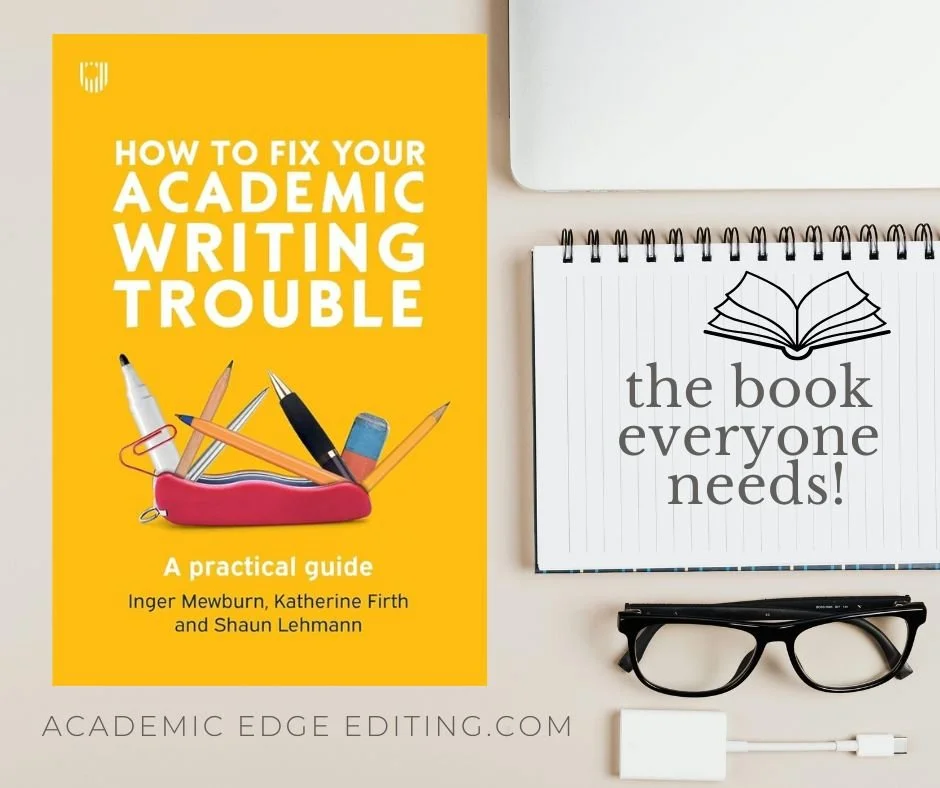
Permission to buy books! Now that I have your attention, it’s time for “the book everyone needs” (otherwise entitled: books I swear by), and this resource is for supervisors and students alike.
This gem has a second edition in the works, but don’t let that stop you from buying it immediately. What I love most is that this book is written with a dual audience in mind.
For the supervisor: rather than repeating yourself when writing feedback, simply hand a copy of the book to your student (or have a wonderful librarian photocopy the appropriate chapter) and say, “Read chapter four”. If you’re a supervisor, this tool will save you hours of meetings and conversations!
For the student: it’s the decoder for supervisor feedback. The chapter headings are almost word-for-word what you find scrawled on the margins of your chapter!
Here are 5 quick reasons why I love this book
This resource is written by people who work daily with postgraduate and early career researchers and are embedded in the (Australian) university academic setting.
The accessibility of the text. I have not yet read a TOC that made my heart sing like this! The ease of identifying what problem area needs attention and how to fix it is what gives this book a 5-star rating in my world.
The content has specific advice for different stages of the writing process.
I use it. I really mean that. I revisit it periodically to become sharper in a particular area and be reminded of best practice!
The tone and clarity of the writing are superb. Getting feedback and critique can hit hard, yet the tone of this book is that of a (very) experienced friend serving a comforting hot beverage and a solid pep-talk. In a space where jargon and ‘high style’ writing can often be obtuse, this book makes clarity its mission.
The 3 main drawcards of this resource
The authors are academic writing experts.
I love that it’s a joint-effort resource: the combined spread of three academics working in university spaces across Australia definitely enriches this resource. Professor Inger Mewburn (director of researcher development at ANU) is best known online as ‘The Thesis Whisperer’ and if you haven’t seen her website yet, I highly recommend it! Dr Katherine Firth (Senior Lecturer in the Research Education and Development team at La Trobe University and Head of Lisa Bellear House, at the University of Melbourne) founded the Research Degree Insiders blog and co-founded the award-winning Thesis Boot Camp program. Together, these two women’s blogs are the saving grace of any PhD student! The third author, Shaun Lehmann (Academic Language and Learning Facilitator at the University of NSW), is their friend and colleague who intriguingly specialises in all things contract cheating from a data-driven perspective. (Anyone who is happy to declare themselves a ‘nerd’ on their bio is my kind of people.)
Between them, the culmination of experience in helping doctoral students is over four decades. They are exactly the right people to be creating this resource!
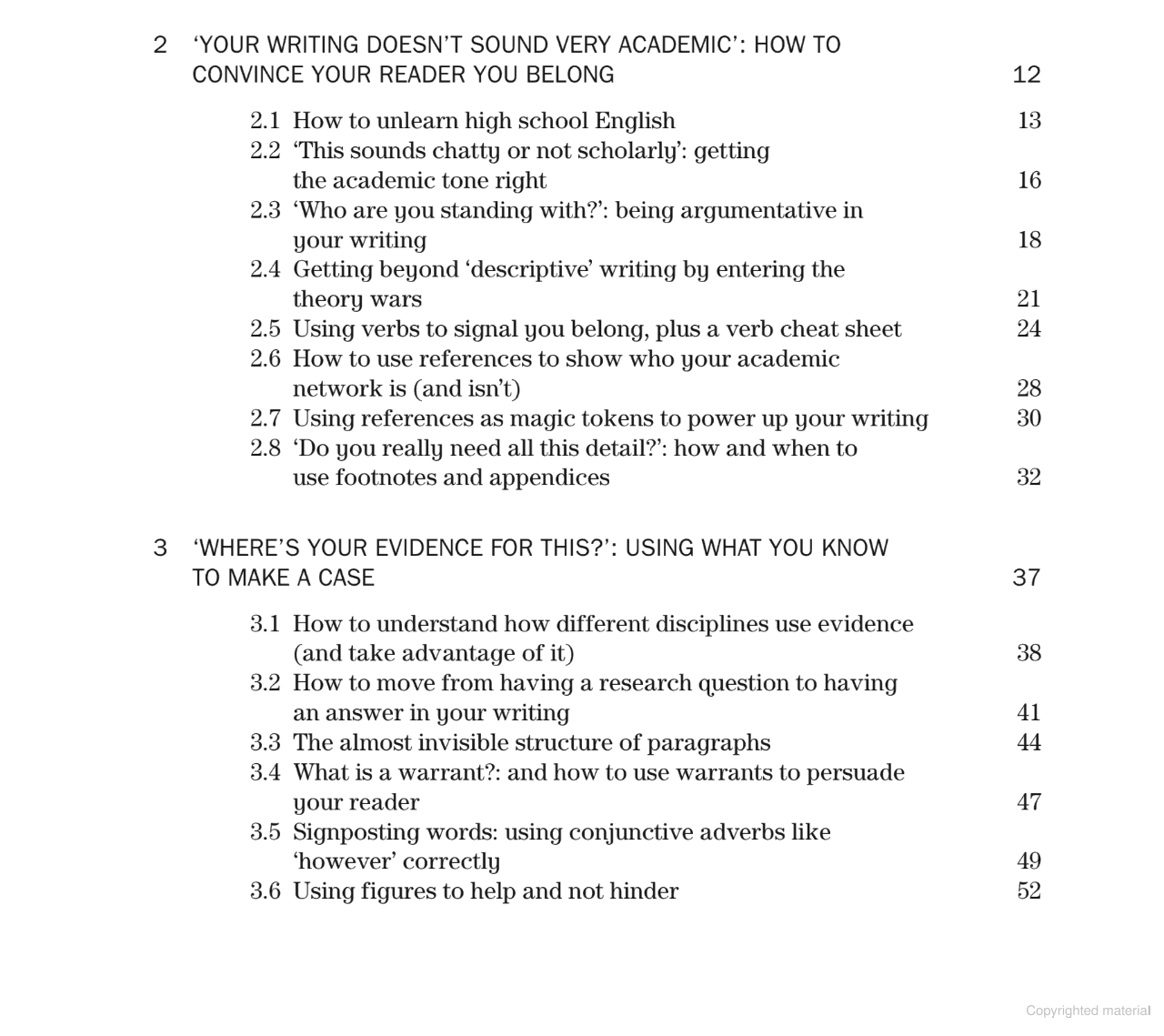
Image: Screen shot of the table of contents (TOC) for How to fix your academic writing trouble. Retrieved from Google books.
Navigation is easy. You’ve never read a TOC like this!
Notice that each chapter starts with a comment that is typical of a supervisor’s feedback scrawled in the margins of a chapter. “Your argument doesn’t flow” (chapter 4), “Too much waffle” (chapter 5), and “Where’s your discussion section?” (chapter 7) make it crystal clear for the student where to start reading. Common issues and solutions are mapped out, often with examples.
If you’re a supervisor, this tool will save you hours of meetings and conversations. Just direct your student to the appropriate chapter (either hand them a copy of the book and say, “read chapter four”, or ask your librarian to photocopy the chapter and email the PDF).
If you’re a student, this tool demystifies feedback and offers a practical approach to polishing your writing. I like to re-read various sections across a year to make sure my writing skills are en pointe.
Difficult concepts are explained with exceptional clarity.
Do you know what a ‘warrant’ is and how to use it? The slippery concept can be hiding behind “how do you know this?” comments, or appear as baked-in assumptions in the argument of a paper. Reading this section (3.4 in the first edition) dramatically improved my writing by helping me identify which statements to defend and which to leave out. This is the most lucid walk-through of warrants I’ve read in over a dozen writing texts. This clarity of expression carries throughout the resource.
Extra kudos to the writers for a collaborative work that maintains a cohesive voice and excels in the skills that they are trying to convey. As a side note, I personally loved the idea of framing my style of writing as “paint the walls, not the Sistine Chapel”. This has freed me to find my own academic voice and continues to help frame the intentions of my writing.
What’s one of your favourite resources? Leave a comment or sign up for my newsletter to get these tools straight to your inbox.
Happy researching! ~Rosey
