
Paradigms reveal patterns
In the last post, I outlined my colour method for faster processing with my dyslexic brain. This one is about cementing paradigms in the stickiest way possible. Yes, there will be colour, but the golden nugget for today is about paradigms.
The best paradigms highlight patterns.
In fact, I’ll go all in on this one and say that the whole point of paradigms is to aid in pattern recognition. The faster you recognise the pattern, the faster you’ll become at reading. So here’s your permission to alter any paradigm that doesn’t make your recognition neurons fire!
Let me show you what I mean.
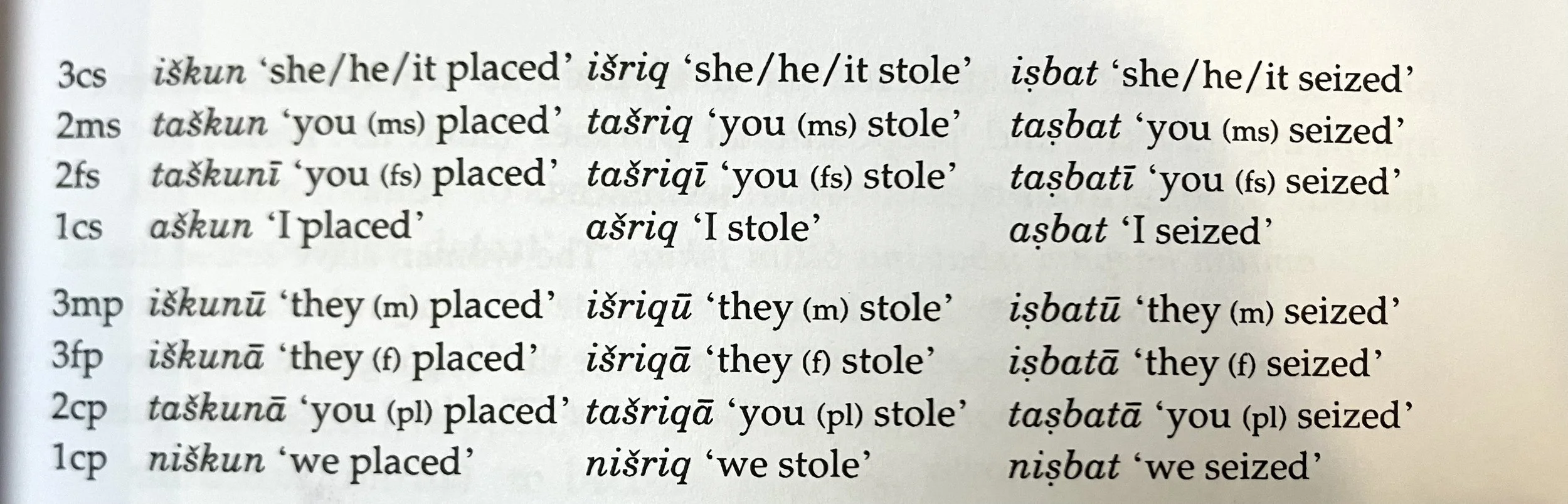
The Akkadian paradigm of the G Preterite form from Huehnergard (3rd edn)
Above is the worst possible tabulation of data for a paradigm that I’ve ever seen. There are three Akkadian verbs in the same table, and everything just blends together.
Here’s my quick pass at rearranging it…
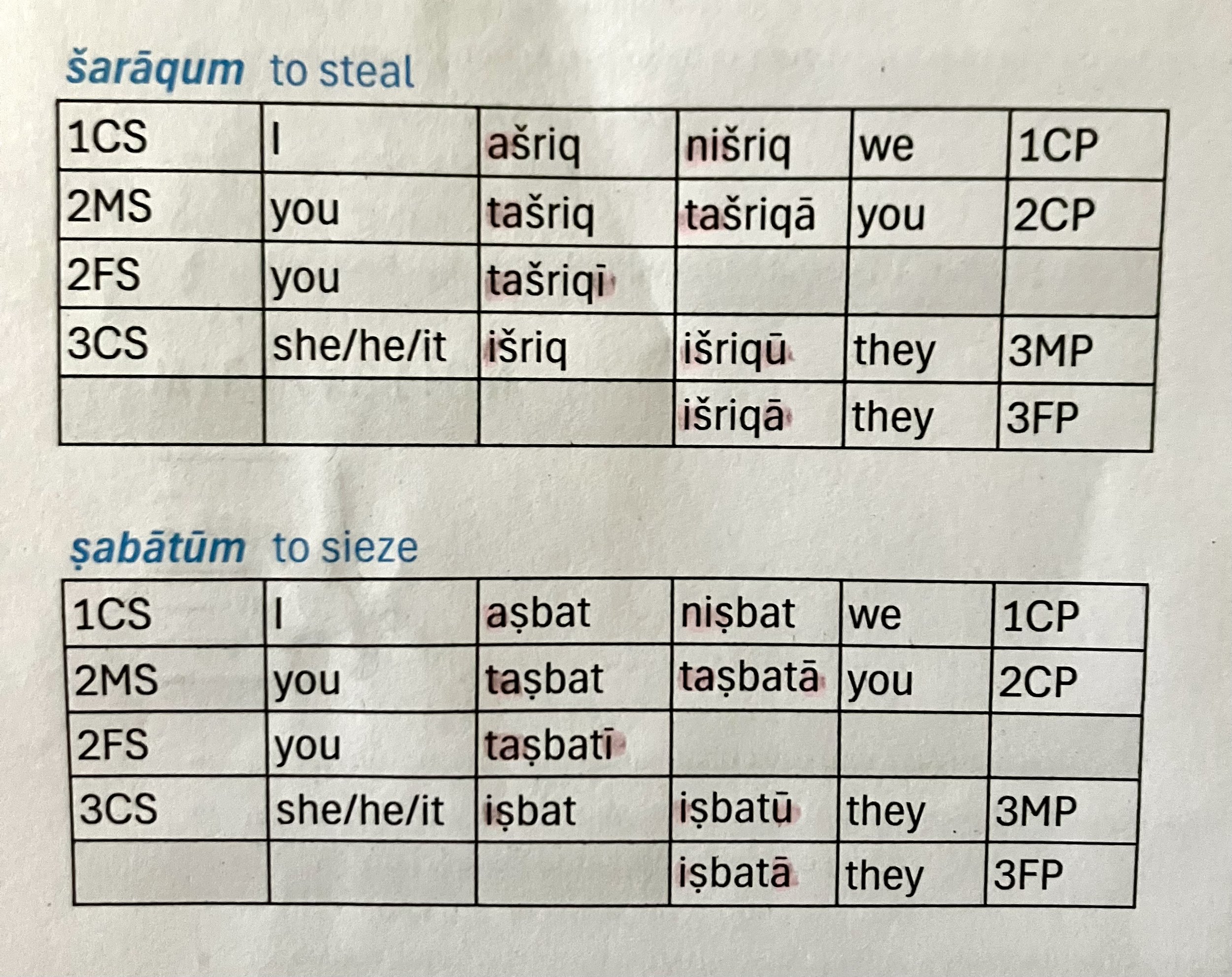
Same information, different layout.
One word/example per table. With the 1st-, 2nd-, and 3rd-person forms lined up and even in a single highlighter colour, I can start to see patterns leap out at me.
the second person forms all have the prefix ta-
the third person forms all have the prefix i-
the first and second persons have a common plural
the first person prefixes are similar to Hebrew
Ok, so that’s a start: a dud reformed with a bit of mono-highlighting. But is that it? What is the pinnacle of paradigm patterning?*
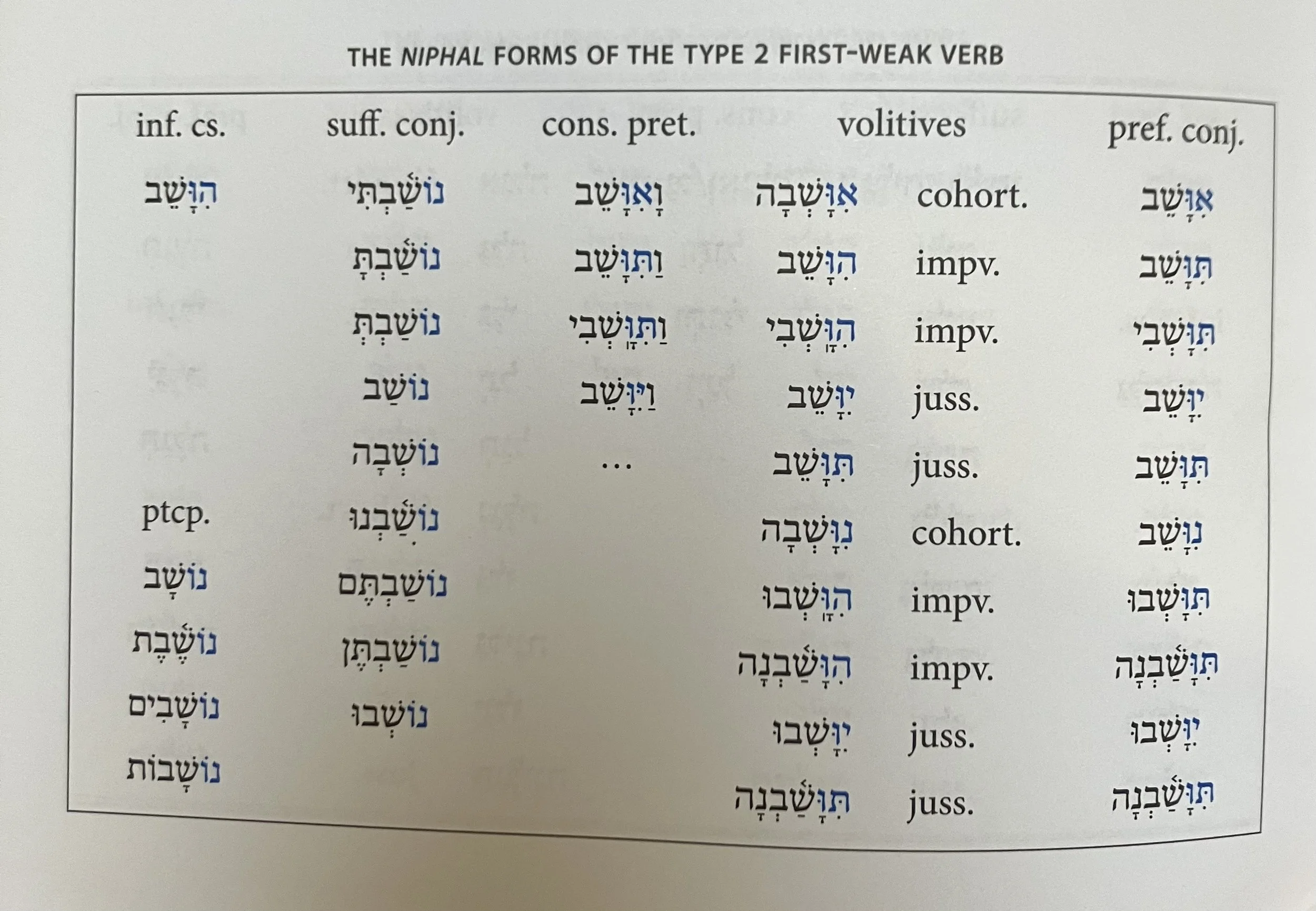
The paradigm tables in the back of Hackett are better than the B&W ones in the chapters.
Above is a sample paradigm of a (weak) Hebrew stem. It uses colour, and the pattern it wants me to notice focuses on the prefix. But all in all, I’m not really going to be reading any faster for this table. (Sorry Jo Ann!)
So here’s how I rearranged all the strong stem paradigms to help me read faster.
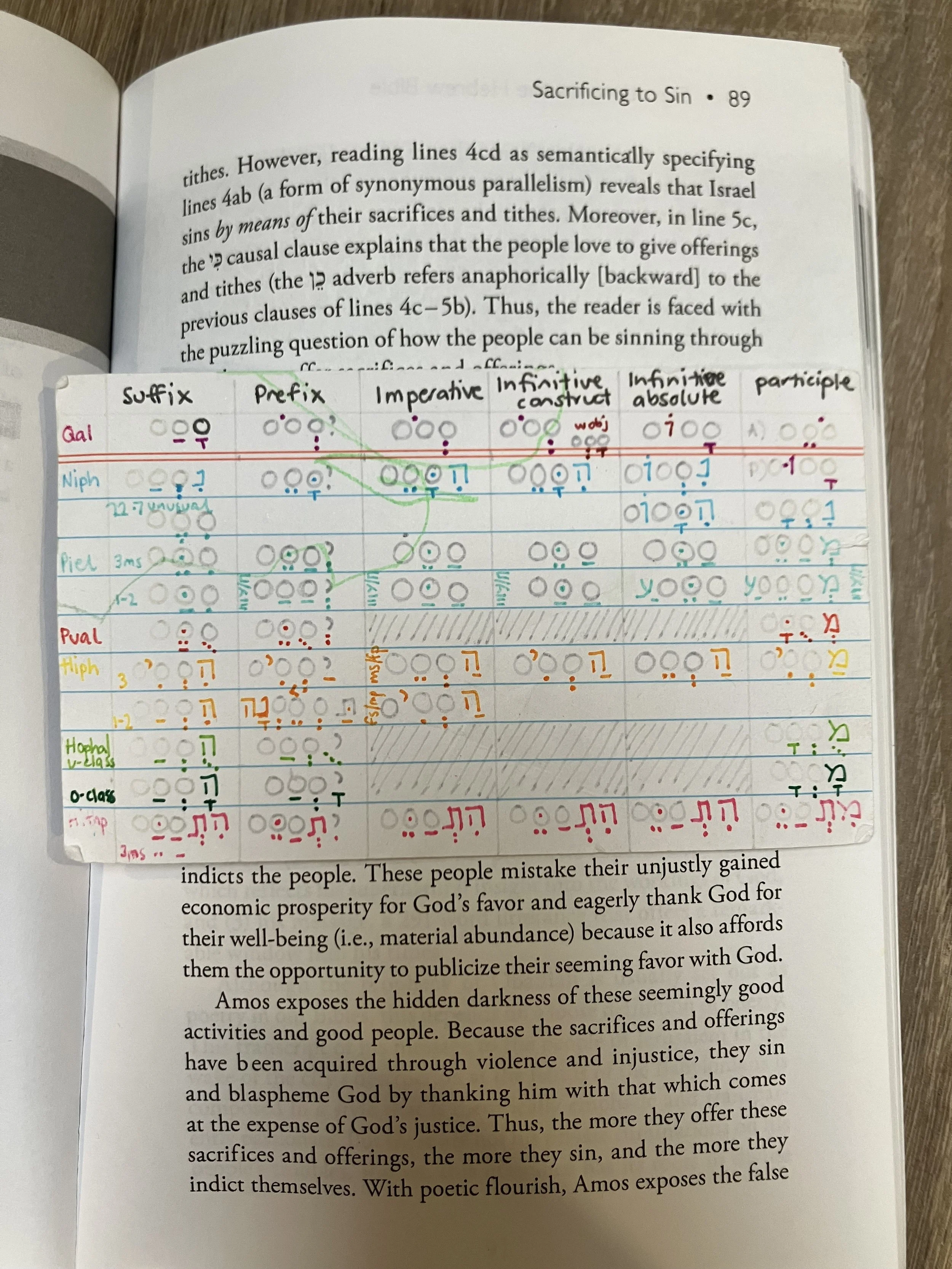
Picture of master paradigm table I made for Biblical Hebrew to speed along my pattern recognition and reading. Green pen additions courtesy of my (then) one year old. Book: Devotions on the Hebrew Bible edited by Eng, & Fields.
I keep this tiny master chart in whichever Hebrew book I’m reading. And for me, it’s a multi-pattern identifier.
Look across to see how a stem morphs for different forms.
Look down to see how a form changes across stems.
When you start to see the similarities between the prefix, imperative, and infinitive constructs, or that the מ-prefix is only used for participles and has the same vowel underneath the leading letter as the prefix conjugation for that stem, then you know that your paradigm is working for you.
I’ve generally found that the more colour I use, the more patterns I can see, the better the paradigm serves me in the long run, and that’s what it’s all about—make paradigms work for your brain. It might take a few tries to get the format right, but that’s ok.
Supercharge your pattern recognition and get to fluency faster!
A special note for language teachers: neuro-spicy brains are generally excellent at pattern recognition; lean into this to help them flourish.
Happy language learning! ~Rosey
*Sorry, I couldn’t resist!
