How to Read a Book
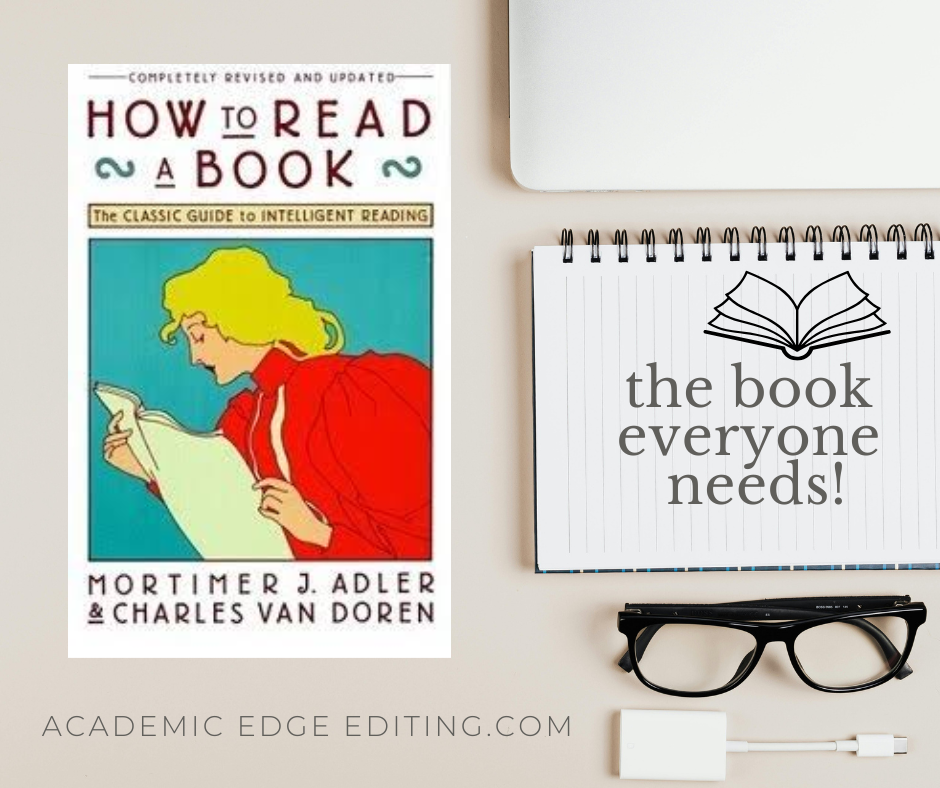
Did you know there are four levels of reading?
And that you’ve only been taught the first two at school?
I found a single copy on the library shelves almost by accident, wedged in between books that were remotely interesting. I remember picking up the book—intrigued—and I was struck by the concept that there were ways of reading that I’d never been taught. This book is Mortimer’s answer to the educational lacuna.
For a book written in 1940 (and substantially revised in 1972), it still holds mighty relevance (sans the patriarchal assumption that all readers are men). But the gold is when you realise that Adler has essentially written the instruction manual on ‘how to eat a book and own it’ (thank you, Mr. Bacon). I’ve read this book 4-5 times now, anytime I feel like I need a booster shot of sharp reading skills, and the short version of the levels of reading are:
Elementary. Taught in primary school as reading for information and entertainment.
Inspectional. Systematic skimming employed by less-than-enthusiastic high schoolers. Mostly ‘what is this about’ at a surface level.
** Time to level up your reading skills**
Analytical Reading. A ‘thorough’ reading. Follow these steps, and you now own this book’s dust-jacketed butt.
Synoptic Reading (also known as Comparative Reading). Several books in dialogue, facilitated by your ownership of all these books, with your own creative synthesis.
The key is to pick which level of reading you’re engaging in at this time and go for it with all the right tools (questions). And Mortimer & van Doren have made a nice stepped-out four part process for each of these stages.

Initially we are taught to read for entertainment, then for accessing information (inspectional reading). As adults we can upskill to read for understanding and ownership of a topic (analyitical reading).
He’s a bit verbose, but let’s cut Mortimer some slack because he has done us a wonderful service. What I see when I look at the later levels is this:
Analytical Reading = how to write the best book review
Synoptic Reading = how to conduct a literature review.
If you’re only in this book for the levelling up (and not for the educational rant) then feel free to skip some of the early chapters. But before you jump into the final two sections, you need his cheat code for “how to be a demanding reader” from chapter 5. It’s all about asking the right questions as you read.
Be a demanding reader
Mortimer wants you to ask these four questions of every book you actively read.
What is this book about as a whole? What is the leading theme and how is it developed?
What is being said in detail, and how? What are the main ideas/assertions/arguments?
Is this book true — in whole or in part? Weigh the evidence and evaluate.
What of it? What is the significance of this book? What will you do now?
He also sets you free to write notes all over the book. Good notes. Specific notes. If you’re of the opinion that writing on a book is the equivalent of book graffiti, check out my ‘cornell method 2.0’ blog post.
This book is brilliant for:
PhD starters—read this before reading everything so that you get the most out of each book and smash that literature review.
Early-career researchers—writing excellent book reviews leads to peer-reviewed publications.
The masters student—your first assessment is usually a book review.
The supervisor—give this book to your floundering newbie.
Anyone who wants to read beyond their current level!
Happy ‘active’ reading! ~ Rosey
